
DCG: Developing a digital, usage-oriented, multilingual terminology resource on transgender vocabulary: methodological challenges, limitations and possible solutions
Name: Océane Foubert
Start : 25/06/2026
End: 26/06/2026
On June 26, Océane Foubert presented a paper entitled “Developing a Digital, Usage-Oriented, Multilingual Terminology Resource on Transgender Vocabulary: Methodological Challenges, Limitations and Possible Solutions” authored by Anna Jamka, Silvia Bonavero, Océane Foubert, Miguel Sánchez Ibáñez, Giovanni Tallarico, and Aleksandra Tomaszewska at the Multilingual Digital Terminology Today (MDTT) conference held at the University of Zadar (Croatia). The 5th edition of the two-day conference brought together people working on terminology and neology, from different horizons: academia, industry and political institutions.
Before presenting the work undertaken in the group “Beyond the Binary” coordinated by Anna Jamka, Océane gave a brief overview of the working groups within which this work is carried out, more specifically W.G 3 “Diachronic and synchronic comparative studies of neology” coordinated by Vincent Balnat and Kris Heylen, and Task 3.6 “Gender & Neology” coordinated by Judit Freixa and Sabela Fernández-Silva
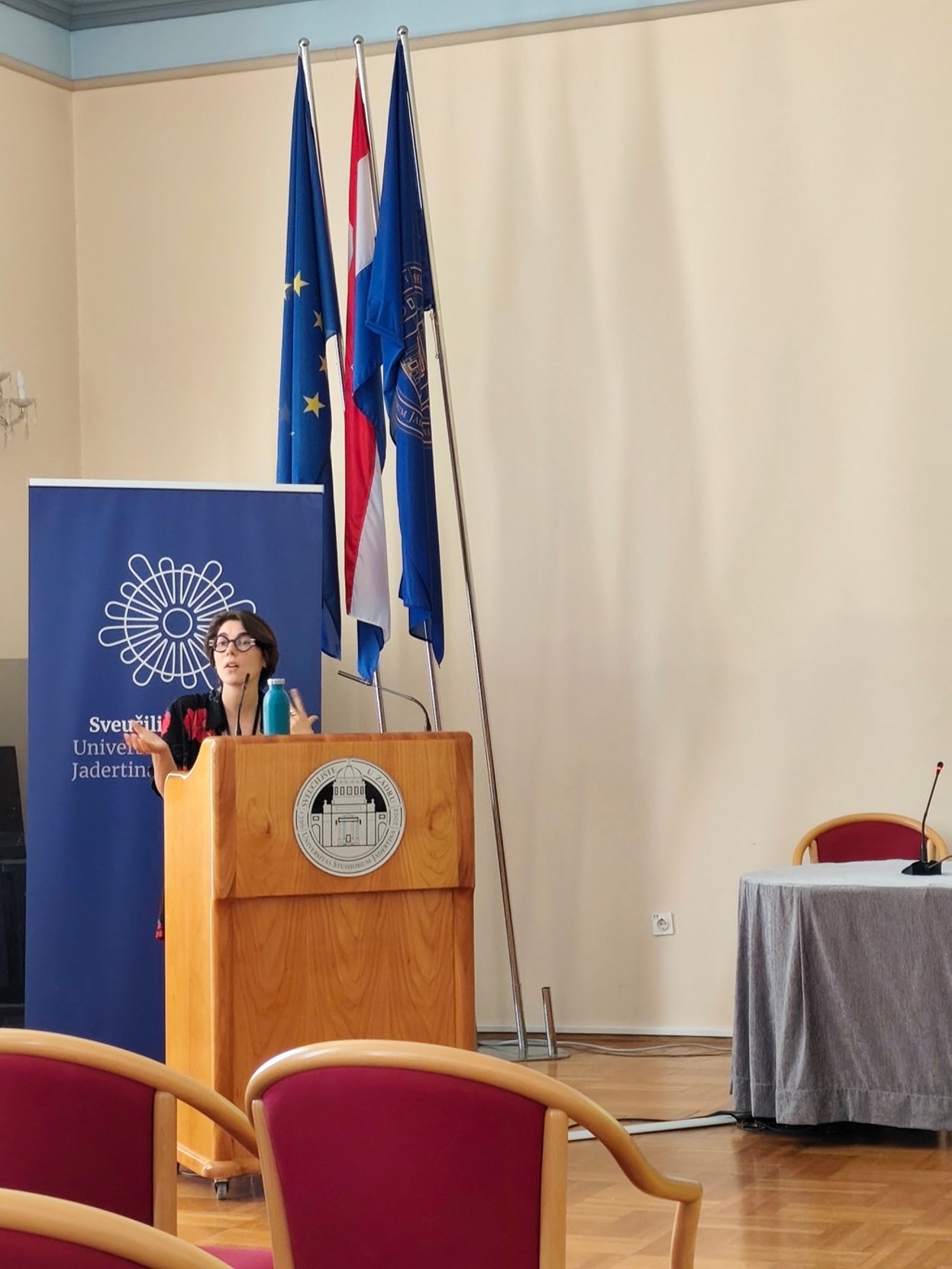
The paper presents the development of a multilingual, usage-oriented terminology resource on trans language. It comprises an annotated glossary documenting key trans-related terms across English, Polish, Spanish, French, and Italian. Adopting a hybrid approach that integrates structured terminology with corpus-documented variation, the resource serves both general audiences, seeking trans-inclusive language guidance, and researchers studying lexical innovation and trans linguistics. We outline conceptual, methodological, and technical challenges encountered during glossary development, like selection criteria limitations, concept definition complexities, corpus adequacy for studying rapidly evolving vocabulary, and terminological difficulties inherent to community-driven, non-standardised lexis. The project intends to fill gaps in existing resources by providing methodological transparency as well as cross-linguistic documentation of trans terminology, while highlighting future research directions in dissident community-driven linguistic innovation.
The presentation of this paper at the MDTT conference proved to be extremely relevant for three main reasons:
- At the starting point of this project is the observation of a lack of transparency in the methodology of existing glossaries on trans vocabulary. Several participants showed similar challenges in their work on terminology, which gave us the opportunity to exchange on what we think is necessary to make our work as transparent as possible.
- Another challenge present in our work is the variety present in the meanings and usages of the terms we analyse. Several presenters asked about how we plan on representing such synchronic, as well as diachronic variation.
- This question is linked to the nature of the terms we analyse, namely rapidly evolving and community-driven trans vocabulary. This raises a more theoretical question addressed by the keynote speaker (Mojca Pecman) on how to integrate such emerging terms with social impact in terminology. More generally, it highlights the clear overlap between neology and terminology that should be further explored in our work.
