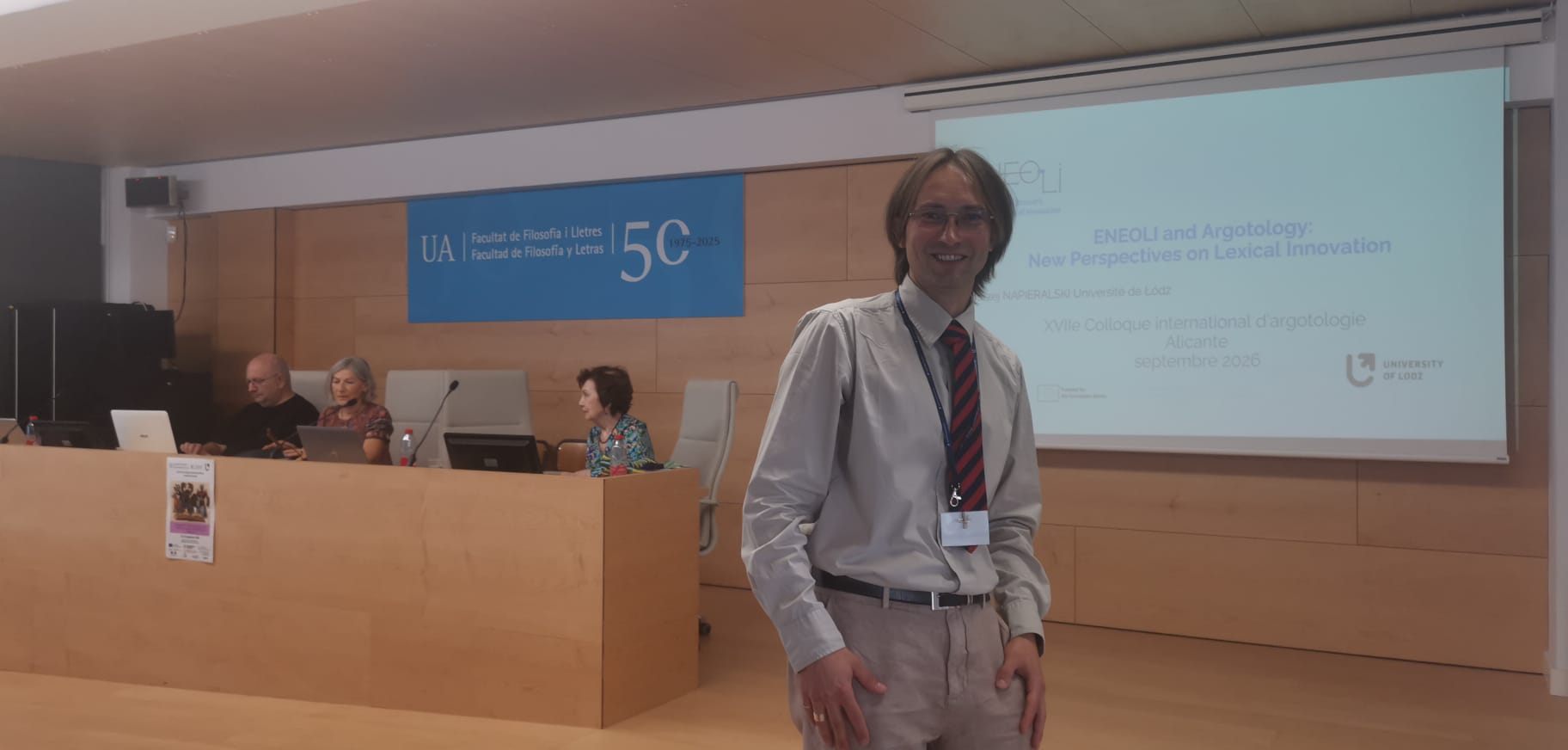
DCG: ENEOLI and Argotology: New Perspectives on Lexical Innovation
Name: Andrzej Napieralski
Start : 23/09/2026
End: 25/09/2026
With the support of a Dissemination Conference Grant, Andrzej Napieralski (University of Łódź) presented the COST Action CA22126 European Network on Lexical Innovation (ENEOLI) at the 17th International Conference on Argotology, held in Alicante in September 2026. His talk, entitled “ENEOLI and Argotology: New Perspectives on Lexical Innovation”, introduced the Action to the international argotology community and explored the points of convergence between neology and the study of slang, sociolects and other forms of non-standard vocabulary.
The presentation outlined ENEOLI’s main objectives and its four Working Groups, highlighting its work on multilingual terminology, digital methods and corpus resources, comparative studies of lexical innovation, and training in neology. Particular attention was given to the ways in which argotology can contribute to the study of lexical innovation by focusing on socially marked, unstable and rapidly circulating forms, including youth language, rap and hip-hop vocabulary, digital discourse and algospeak. The talk emphasised the importance of tracing lexical items through processes of emergence, diffusion and stabilisation, and of examining how social groups, media, digital platforms and dictionaries participate in their circulation and legitimisation.
A central part of the presentation focused on Task Group 3.8 “Argotisms and Neologisms”, coordinated by Anne Gensane and Andrzej Napieralski within Working Group 3. The group brings together researchers working at the intersection of neology, argotology, sociolects, digital discourse and urban cultures, with the aim of developing a comparative framework for studying socially marked and emerging lexical forms across languages. Its research agenda includes the distinction between argotisms, neologisms and occasionalisms, lexicogenic processes, the circulation of innovations between restricted groups, rap, social media, the press and dictionaries, as well as the construction of comparable corpora for unstable and rapidly evolving usages.
The Alicante conference also provided an opportunity to present the first activities and future perspectives of WG3.8, following the group’s contributions at the 2026 ENEOLI meeting in Prague. The presentation highlighted ongoing work on lexical creativity, digital discourse, language contact and lexical circulation, together with plans to develop collaborative comparative research and a future collective publication on the interface between argotology and neology. More broadly, the contribution showed how ENEOLI can provide argotologists with shared terminology, corpus-based methodologies, comparative perspectives and new opportunities for international scientific cooperation.