
DCG: Gender, Power, and Lexical Innovation in the 21st century Slavic Languages
Name: Anna Jamka
Start : 10/04/2026
End: 12/04/2026
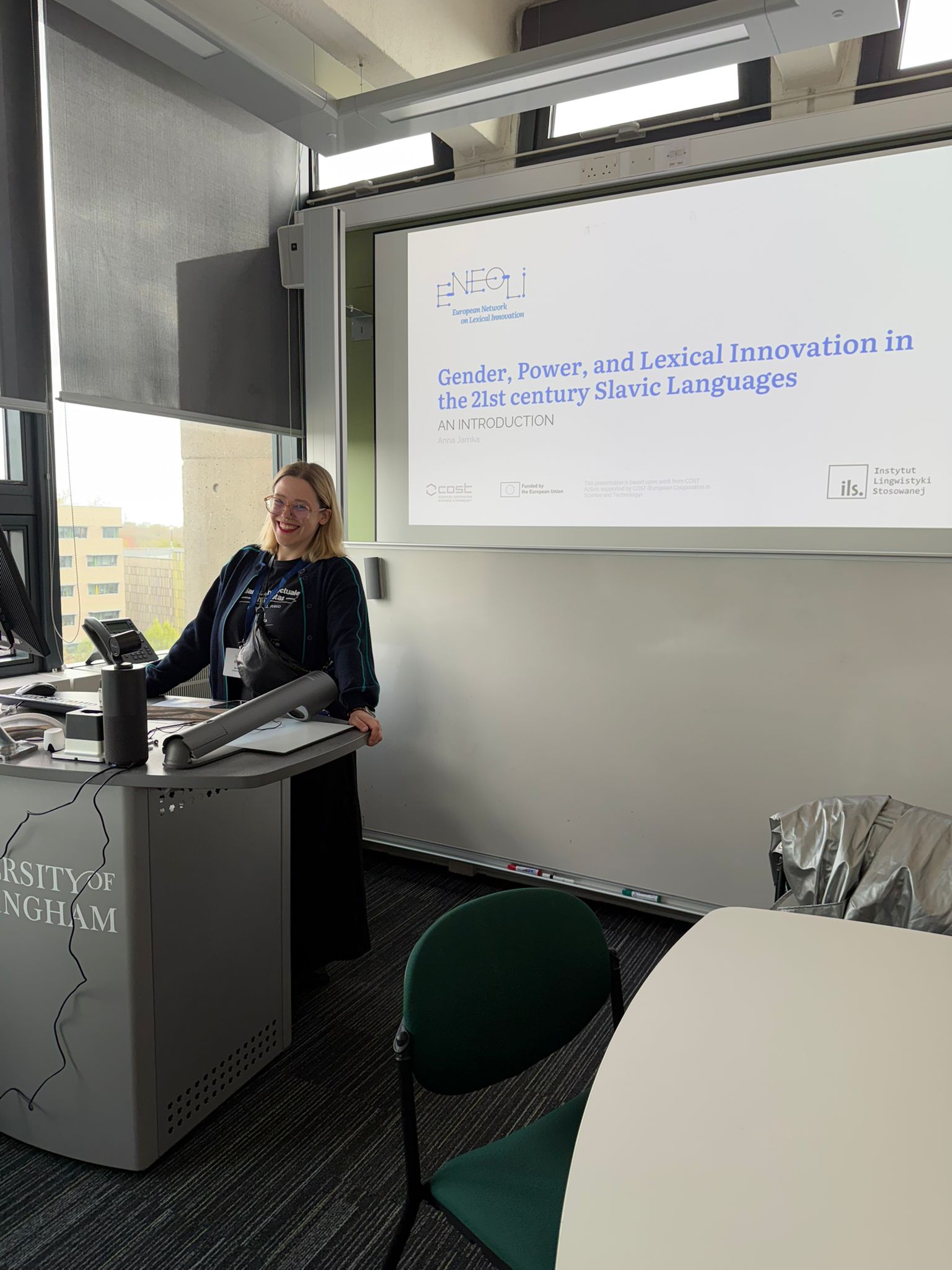
On April 11, Anna Jamka hosted a panel on gender-related lexical innovation in Slavic languages at the BASEES Annual Conference 2026 held at the University of Birmingham (10-12 April). This event, organized by the British Association for Slavonic and East European Studies, a UK national learned society, is one of the key venues for discussing such matters in Europe. As it brings together an international and interdisciplinary mix of scholars, early-career researchers, and non-academic experts, it is a great platform for ENEOLI to reach a wider audience beyond linguists.
The presentation Anna gave—Gender, Power, and Lexical Innovation in the 21st century Slavic Languages—served as an introduction to the panel under the same title. It proved to be a great opportunity to showcase WG3’s work, particularly this related to the study of gender and neology, under Task 3.6., coordinated by Judit Freixa and Sabela Fernández-Silva. In the presentation, Anna introduced the ongoing work of the subtask 3.63, that is, Gender and Neology across Slavic Languages.
One of the key takeaways—-from Anna’s presentation, the four papers composing the panel, and the resulting discussions—-was that lexical innovation is not just a linguistic phenomenon, but a deeply social process that benefits from being analysed within wider cultural and political contexts.
We established that studying new, gender-related, vocabulary allows us to better capture the dynamics between norms, inclusion, and representation, as seen in the examples of gender identity vocabulary or asymmetries in gender stereotypes revealed in new lexis. Studying gender-related lexical innovations also lets us grasp the tensions between dominant and resistant discourses, as observed, e.g., in the case of the Russification vs. decolonisation debate in the Ukrainian language. Research on gender neology is also a great opportunity to better understand differences when it comes to usage and codification of such lexis, as it is the case of e.g. gender identity vocabulary and its absence from major dictionaries or differing usage of sex-work-related terminology across activists, academics and other language users.
Anna and the rest of the presenters concluded that gender-related lexical innovation serves multiple functions: it allows for building identities, reframes social roles, and may challenge or reproduce stereotypes.
