
Original idea: Corina Veleanu
Conceptualization: Adrian Majuru
Exhibition curator: Roxana Barbu
Organization: Onorina Botezat, Giovanni Tallarico, Eliana Radu (Bucharest), Radka Mudrochová (Prague)
ENEOLI, the COST Action 22126 European Network on Lexical Innovation, is an international research initiative dedicated to the study of neology—the process through which new words and expressions emerge, evolve, and become integrated into languages. Recognizing that lexical innovation is a continuous and universal phenomenon, ENEOLI brings together a diverse community of more than 400 researchers, educators, students, translators, journalists, and policymakers interested in understanding and shaping the dynamics of language change across different linguistic and cultural contexts. The main objective of the Action is to advance the field of neology by refining its terminology, promoting innovative methodologies, conducting comparative studies across languages, and providing specialized training to various stakeholders. By fostering interdisciplinary collaboration and knowledge exchange, ENEOLI aims to build a coherent and sustainable research framework for the study of lexical innovation at the European and global levels. In addition to its research activities, ENEOLI promotes collaboration, mobility, and capacity building through events, training opportunities, and shared resources. By integrating theoretical, methodological, and applied perspectives, this COST Action contributes to a deeper understanding of how languages evolve and how societies adapt to ongoing linguistic change.

The Neologism of the Week campaign, launched by ENEOLI, is a dynamic science communication initiative designed to bring the study of neology closer to a broad and diverse audience. Built around the hashtag #tuesdayneologism, the campaign highlights newly coined words and expressions that have gained relevance in contemporary usage, offering accessible explanations of how language evolves in real time. We have published until now more 100 neologisms in English (eneolist), French (climaticide, JOstalgie), Dutch (zelfscansamenleving), Italian (sgrammatura), Romanian (agropensiune), Albanian (kujtimore), Polish (punktoza), German (stapelschuldgefühl), Slovene (ocenomanija), Portuguese (cibercondria), Spanish (biberódromo), Basque (segapoto) and counting.
From its early stages, ENEOLI’s chair Giovanni Tallarico envisioned the campaign as a bridge between academic research and everyday linguistic experience, while also fostering multilingualism. Each weekly feature combines carefully crafted texts with custom-made visual materials, including illustrations and posters, written and designed by Onorina Botezat and Sorina Ciobanu, to present neologisms in an engaging and visually coherent format aligned with the Action’s identity. This integrated approach ensures that complex linguistic concepts are communicated clearly and attractively across digital platforms. The initiative also emphasizes participation and community building. Audiences are invited to contribute their own neologisms, while ENEOLI members actively share examples from a wide range of languages, reflecting the network’s commitment to linguistic diversity. By doing so, the campaign not only documents lexical innovation but also encourages dialogue around the cultural, social, and technological forces that shape language.
Coordinated by the ENEOLI Communication Team, Špela Arhar Holdt (2024/2025) & Onorina Botezat (2025 onwards) the campaign benefits from a collaborative workflow: weekly entries are prepared and published on the website, while accompanying social media content is designed and disseminated to maximize outreach and engagement. This consistent effort has contributed to the campaign’s visibility and impact, leading to its recognition by the COST Association in March 2025 as a best practice example in dissemination. Beyond its promotional role, “Neologism of the Week” serves as an educational resource and a repository of contemporary language change. By linking scholarly research to real-world usage, it highlights the creativity, adaptability, and expressive power of language. Ultimately, the campaign underscores the importance of neology as a field of study, while fostering curiosity and appreciation for the ever-evolving ways in which people communicate.
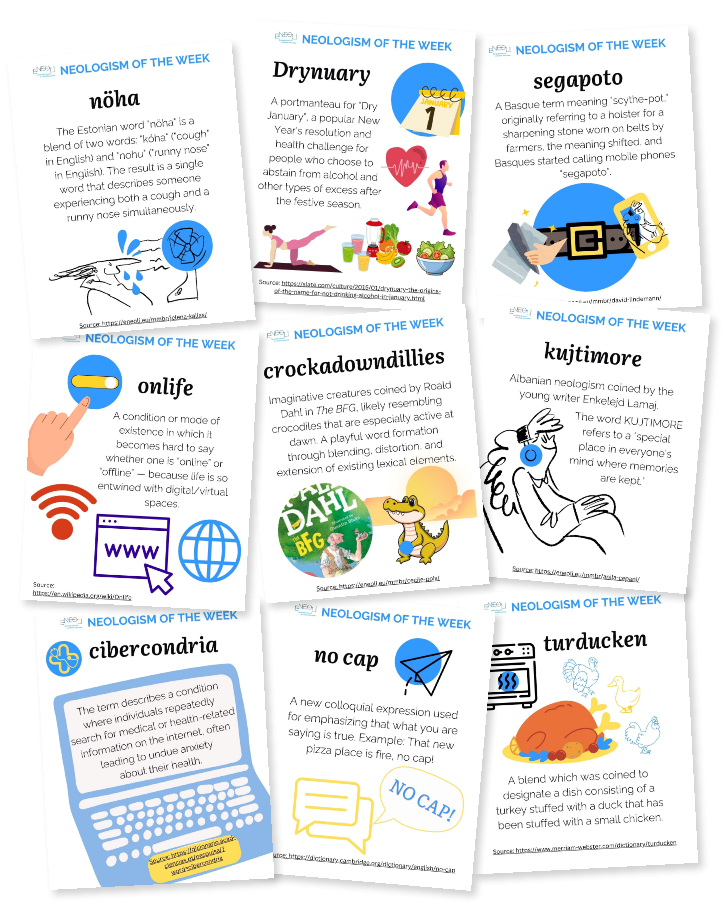
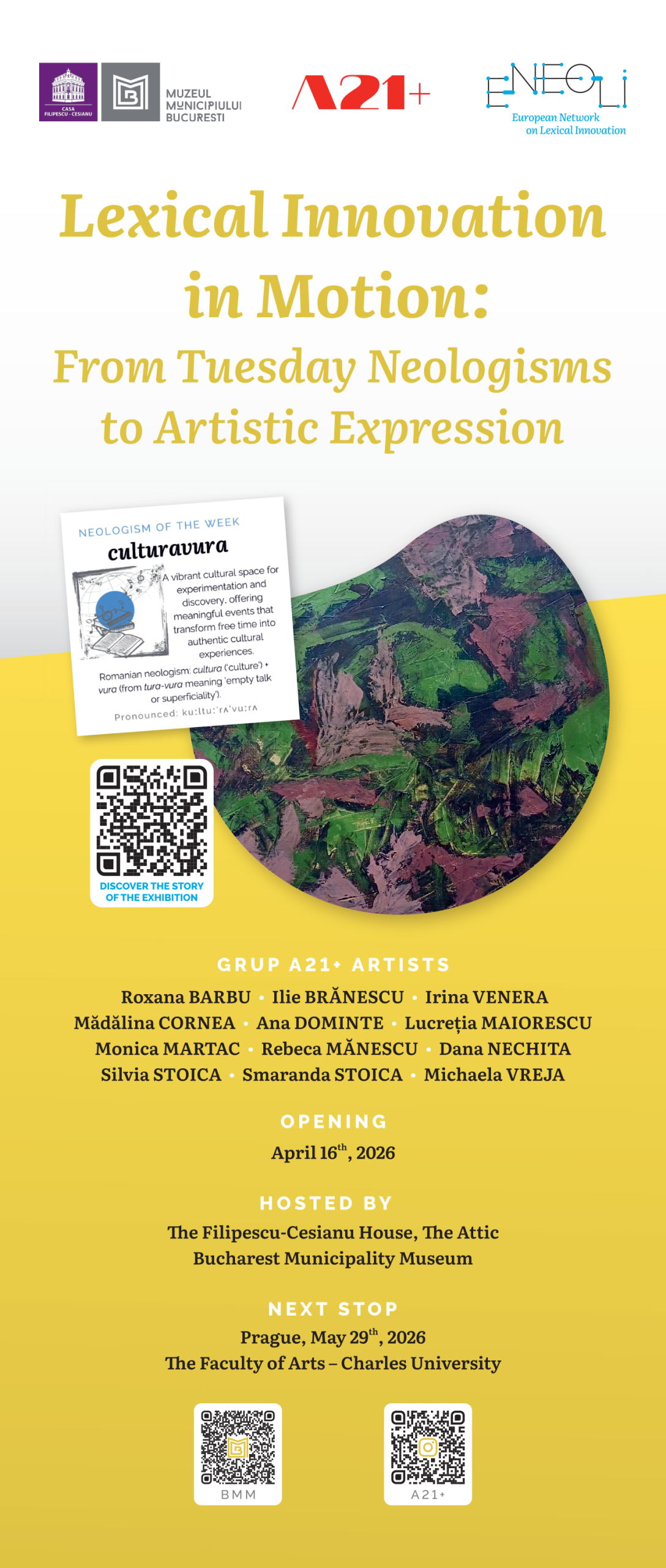
Building on the success of the Neologism of the Week campaign, the project naturally evolved toward a new form of expression, one that moves beyond explanation and into visual interpretation. If the campaign made new words visible and accessible through language and design, the next step was to explore how these same neologisms could be translated into art. This transition gave rise to an innovative exhibition concept situated at the intersection of linguistics and artistic practice. Rooted in the mission of the Museum of Bucharest to promote intangible heritage and engage the public with contemporary cultural dynamics, the exhibition invites artists to reinterpret lexical innovation through visual media. In this context, neologisms are no longer just objects of study, they become sources of inspiration, emotion, and creative exploration.
The idea of an exhibition of new words was brought forth by Corina Veleanu following a lecture held in May 2025 by Joana Sousa Monteiro, Director of the Museum of the City of Lisbon, which sparked a dialogue on how language, culture, and museums can intersect in new and meaningful ways. This exchange, further enriched by institutional and cultural collaboration, led to the development of a “travelling exhibition” concept suggested by Joana Sousa Monteiro and centered on neology. The initial aim of this innovative approach, at the crossroads of linguistics and artistic expression, was to encourage reflection and artistic creation based on neologisms identified as part of the ENEOLI project, and to highlight the perception and reception of new words. Young artists could thus artistically express their feelings and ideas related to neologisms through visual artefacts, writings or other media, and these artistic productions inspired by new words could then be displayed to the general public. Further conversations held by Corina Veleanu with Prof. Cătălin D. Constantin, book editor and anthropologist at the Faculty of Letters of the University of Bucharest, known for his work and individual international exhibitions dedicated to the Romanian cultural heritage (Spain, Türkiye, Bulgaria, Azerbaijan, Georgia, Poland, Greece, Ireland, Italy and Portugal), consolidated the interdisciplinary approach and led to meaningful exchanges with Adrian Majuru, the manager of the Museum of the City of Bucharest and professor of urban anthropology and human geography at the University of Architecture and Urbanism – Ion Mincu (Bucharest) who expressed a keen interest in helping organize and host this original exhibition and provided valuable ideas, contacts and access to Romanian artists.
At the heart of the exhibition lies a simple yet powerful gesture: artists select their own neologisms, words that resonate with them personally or culturally, and reinterpret them through artistic forms such as painting, drawing, collage, or mixed media. Rather than illustrating definitions, they explore the perception, emotion, and imagination that these new words evoke. In doing so, each artwork becomes a visual reflection of how language is experienced, internalized, and transformed.
This approach encourages a dialogue between disciplines, turning linguistic research into a catalyst for artistic creation. It also reinforces the broader aim of the ENEOLI initiative as it was highlighted by Giovanni Tallarico: to bring neology closer to the public and to “make language visible.” Through the artists’ perspectives, abstract linguistic processes acquire form, color, and texture, revealing the deeply human dimension of how new words emerge and circulate within society. Ultimately, the exhibition extends the life of neologisms beyond the page or screen, offering audiences a multisensory experience of language in motion—where words are not only read or heard, but also seen and felt.

Founded at the beginning of 2024, Group A21+ (between 2024–2025, the group operated under the name Atelier 21+) brings together graduates of the Painting class of 2018–2021, under the guidance of professor Cezar Atodiresei, who are currently artists and members of the Bucharest Painting Branch. From the very moment of its formation, Silvia Stoica joined the group, a faculty member at the National University of Arts in Bucharest, visual artist, and member of the U.A.P. Bucharest Painting Branch. Although eclectic in the diversity of artistic visions, the group demonstrates its unity through the shared intention of paying tribute to the values and knowledge transmitted by Professor Atodiresei, who left a profound mark on each member’s artistic journey. Strengthened through consistent involvement in various artistic projects and the preservation of cohesion among its members, Group A21+ aims to organize annual, recurring series of exhibitions as part of an evolving, structured process with a long-term perspective.
Over the two years since its establishment, Group A21+ has organized a series of exhibition events hosted in art galleries in Bucharest and across the country, initiating the annual artistic residency “Summer at the Palace,” held at the “Brâncovenesc Palaces at the Gates of Bucharest” Cultural Center in Mogoșoaia. In 2025, the group launched its first editorial project, a substantial art catalog—a publication reflecting the diversity, depth, and quality of the artists’ visual practices. For 2026, Group A21+ is preparing a series of events, including: an exhibition at the National Museum of the Romanian Peasant, at the Bucharest Municipality Museum – Filipescu-Cesianu House, as well as an artistic residency and exhibition at the “Brâncovenesc Palaces at the Gates of Bucharest” Cultural Center in Mogoșoaia.
Hosted in the attic of the Filipescu-Cesianu House, part of the Bucharest Municipality Museum, one of the few aristocratic residences in Bucharest dating from 1846–1850 and faithfully preserved according to its original design, 16-19 of April, 2026, the Lexical Innovation in Motion: From Tuesday Neologisms to Artistic Expression exhibition enters into dialogue with the Museum of Ages, a narrative journey of intimacy and intergenerational relationships which, using Bucharest as a case study, explores Romanian urban life from the 18th century to the present.
