1st ENEOLI Training School on Lexical Innovation: A Milestone for Collaborative Research and Training in Neology
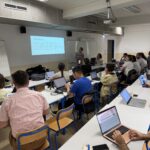
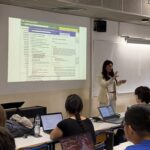
The 1st ENEOLI Training School on Lexical Innovation took place from 9 to 13 June 2025 at the Faculdade de Ciências Sociais e Humanas (FCSH) of the Universidade NOVA de Lisboa, hosted by NOVA CLUNL. This event marked an important step in the activities of the European Network on Lexical Innovation (ENEOLI), particularly reinforcing the objectives of Working Group 2 (Methods, Digital Resources and Tools for Neology).

The main goal of this first Training School was to introduce participants to the key concepts, tools, and methodologies for understanding and analysing lexical innovation. Over the course of five days, participants engaged in lectures and workshops that bridged theory and practice, exploring real-world data and applications.
The program fostered a dynamic and interactive environment where trainees were encouraged to share their experiences, needs, and perspectives, thus enriching the collective learning process. Beyond skill development, the Training School also served as a platform for international collaboration, enabling the creation of new academic and professional networks that will continue to support ENEOLI’s mission in the years to come.
The Training School brought together a highly international and interdisciplinary team of trainers, including:
- Gearóic Ó Cleircin, Dublin City University, Ireland
- Uri Horesh, University of St Andrews, United Kingdom
- Kris Heylen, Instituut voor de Nederlandse Taal, The Netherlands
- Iztok Kosem, University of Ljubljana and Jozef Stefan Institute, Slovenia
- David Lindemann, University of the Basque Country, Spain
- Ana Salgado, NOVA CLUNL, Portugal
- Miguel Sánchez Ibánez, Universidad de Valladolid, Spain
- Petra Storjohann, IDS Mannheim, Germany
- Anna Vacalopoulou, Institute for Language and Speech Processing, Greece
- Federica Vezzani, University of Padova, Italy
Their contributions ensured a rich and comprehensive overview of current approaches to lexical innovation from linguistic, computational, and cultural perspectives.
Interest in the Training School was remarkable, with 55 applications received from around the world. After careful selection based on academic merit and motivation, 25 trainees were admitted — 15 with fellowships and 10 self-funded participants. The group represented 16 countries, including the Czech Republic, Denmark, France, Georgia, Germany, Iceland, Italy, Montenegro, Poland, Portugal, Serbia, Slovakia, Spain, Ukraine, the United Kingdom, and Canada. Among the participants, 18 identified as female, 6 as male, and 1 preferred not to say, reflecting ENEOLI’s ongoing commitment to diversity and inclusion in academic training.
The 1st ENEOLI Training School on Lexical Innovation successfully established a model for future editions, combining academic excellence with a spirit of collaboration and innovation. Participants left Lisbon with new insights, skills, and connections, ready to contribute to the growing field of lexical innovation.
ENEOLI looks forward to continuing this series of Training Schools across Europe, further strengthening its network and advancing research and education in neology.