

The 3rd ENEOLI General Meeting took place in Prague, 28–29 May 2026, at the Faculty of Arts, Charles University.
Local organizer: Radka Mudrochová

The first day was dedicated to the Core Group Meeting in the morning and the Management Committee Meeting in the afternoon.

Highlights of the second day:
- Keynote speech: The Neology of War: Multilingual, Multimodal, AI-enhanced Digital Neography for Research, Education, and Resilience by Rusudan Machachashvili.
The Neology of War in Ukraine: Multilingual, Multimodal, AI-Enhanced Digital Neography for Research, Education, and Resilience traces the wartime Ukrainian neolexicon across thematic clusters and structural trends: from Resistance Memes and Folk Neography to War Crimes and Accountability, from Civil Resilience and the Homefront to the AI/NLP Ecosystem powering it all. At the core is The Glossary of War – a live AI-powered digital archive of Ukrainian full-range invasion language, built in real time since February 24, 2022. Discover how multimodal entries become NLP training data, propaganda detectors, and a record of resilience that will outlive the war that made it.

- Working Group Meetings.
WG1 Workshop 1: Populating NeoVoc Hands-on workshop
The aim of the workshop was to guide the participants through the process of contributing to NeoVoc. The session was led by Anna Vacalopoulou, who went through all the steps required to access the system and to enter and organise data. Those taking part, a dozen participants, were experienced contributors, such as Anila Çepani and her colleagues for Albanian or Jurgita Mikelionienė for Lithuanian, or members who had barely used the platform. Languages worked on included Dutch, Romanian, and Turkish. Examples of points addressed during the all-too-short session were issues of downloading and working offline, and addressing warnings in pre-filled concept equivalents. Other issues raised concerned the degree of completion required for inclusion in the deliverables and other topics, which will be addressed at the Vienna meeting.

WG1 Workshop 2: From Classification to Modelling
This workshop was intended to raise and discuss issues brought to light by the work of Task 1.3, under the leadership of Margarida Ramos. Three topics were broached.
Cécile Poix, Classification and Current Challenges: This paper is a call for action based on the multidimensional nature of (neological/linguistic/theoretical) terms and poses the question: How can this multidimensionality be implemented in Neovoc ?
Mike Rosner, Ontology-based tools for neology: After introducing ontology tools (RDF, OWL…) Mike proposed three tools for NeoVoc
- NeoCheck: to foster consistency (and involve revision)
- NeoClassify: to classify new words as they crop up
- NeoGen: to generate candidate-neologisms
Anna Vacolopoulous and Ilan Kernerman, Introducing the Editorial Style Guide for the ENEOLI Multilingual Glossary of Neology


WG 2 Workshop: Tools for the detection and analysis of lexical innovation
Ana Ostroški Anić & Federica Vezzani, Introduction
Maciej Ogrodniczuk, NeoN in practice: detecting new words in the Polish parliament
Mauro Le Donne, The Trend corpora: a resource to study the micro-diachrony of lexical innovations in different languages
Nina Hosseini Kivanani, Words in contact. Lexical innovation in Luxembourgish from news to LLMs
Discussion: From resources to the Repository of Lexical Innovation


Task Group 3.1 “Blends” (Alina VILLALVA & Sara PITA)
Workshop: Studies on Blending. During the session, three studies were presented that examined lexical blending across different languages and contexts. Monica Vasileanu analysed 102 Romanian blends: Structural Patterns in Borrowed and Native Romanian Blends, distinguishing between loanwords, native formations, and loan translations, and found systematic structural differences between borrowed and native blends. Sara Pita focused on 40 blends in Portuguese translations of children’s comics like Gravity Falls, Dog Man, and Minecraft: Lexical Innovation in Portuguese Children’s Books: The Case of Blending, showing that blends enhance creativity and narrative engagement. Ivana Lazić-Konjik & Vanja Miljković examined 70 newly coined blends in Serbian political discourse (2024–2026), Blends in Serbian Protest Discourse (2024–2026): A Derivational and Semantic Analysis, demonstrating their role as tools of critique, evaluation, and symbolic resistance, especially in protest contexts. The session will include a discussion of future work on the translatability of blends.
Task Group 3.2 “Neology & Discourse” (Petra STORJOHANN & Besim KABASHI)
Workshop: Cracking Neo-Discourses: From Micro-Markers to Bigger Structures and Narratives. The aim of the workshop is to learn about methodologies for employing corpora beyond mere validity testing. Specifically, it will illustrate how to critically examine texts and corpora in order to identify salient patterns and distinctive lexical markers associated with a single controversial neologism, thereby revealing dimensions of power, ideology, identity, emotion, polarisation and opinion. The absence of certain patterns as a discourse strategy for framing a narrative will also be discussed. Participants will further engage with strategies for identifying lexical cues that illuminate identity construction within discourse. At the end, a recent study on Albanian neologisms in public hate speech will be presented by K. Canaj. She will introduce her research, highlighting newly identified patterns of abusive language, and demonstrate how political and cultural writing makes extensive use of metaphor.


Task Group 3.4 “Phonological, orthographic, grammatical and semantic inclusion of neologisms in our mental lexicon” (Esther BREUER)
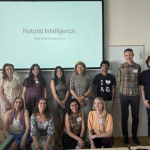
Workshop: “Natural Intelligence versus AI in understanding and creating neologisms: the state of the art, plans for publication of methods and discussion of next steps” Task Group 3.4 is dealing with neologisms in cognitive linguistics, comparing how humans and ChatBots understand them, rate them and create them. The session focused on the results of the experiments so far, the tests that are being developed (and the results of the pretest), and ideas for generating new (funded) projects, in order to make sure that the task will be able to proceed with the very productive collaboration.
Task Group 3.6 “Neology and Gender Equality in the Languages of Europe” (Judit FREIXA & Sabela FERNANDEZ SILVA)
Workshop: “Neologisms and Gender Equality” The session Neologisms and Gender Equality (hybrid format, 90’) brings together the coordinators of collaborative working groups to present collective insights into how emerging words shape contemporary debates on gender. The session highlights the results of joint work carried out by the WG3 Neology and Gender group over the past eighteen months. Contributions will cover key topics such as gender-related neologisms in lexicography and media, non-binary language innovation, English influence, and developments in Slavic languages. A central feature will be the presentation of a multilingual database of gender neologisms. This session offers a unique overview of coordinated, cross-linguistic research within the Eneoli community. It invites participants to reflect on the role of linguistic innovation in advancing gender equality and inclusivity.
Task Group 3.8 “Argotism and Neologisms. Lexicogenic Processes, Social Dynamics, and Discursive Circulations” (Anne GENSANE & Andrzej NAPIERALSKI)
Workshop: “Argotism and Neologisms” La session ARGOTISMS AND NEOLOGISMS Lexicogenic Processes, Social Dynamics, and Discursive Circulations (format hybride) explore les liens entre néologie et argotologie en analysant l’émergence et la circulation de formes lexicales innovantes dans des communautés socialement marquées. Elle met en lumière divers procédés de création (verlanisation, troncation, emprunts, hybridations) ainsi que leurs fonctions expressives et identitaires. À partir de corpus variés, les interventions abordent des thèmes tels que : le lexique des émotions chez les jeunes, les néologismes du hip-hop et l’algospeak. La session vise également à préciser les critères permettant de distinguer argotisme et néologisme. Elle prévoit ainsi de produire un premier aperçu des dynamiques actuelles de l’innovation lexicale étudiées dans notre groupe, en articulant mécanismes linguistiques et usages sociaux.


WG 4 Development of teaching materials
Judit Freixa & Petar Božović: Introduction
Umberto Bilotti: Teaching neology with AI
Michaela Hrotekova: Teaching neology with multimedia and interactive materials
Eriola Qafzezi: Teaching neology with specialised texts
Cécile Poix: Teaching neology with fiction and audiovisual texts
Amal Haddad: Teaching neology with journalistic texts
Petar Božović: WG4 Tirana School



- The Young Researchers and Innovators (YRI) session.
- The art exhibition, Lexical Innovation in Motion
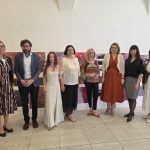
The second stop of the exhibition Lexical Innovation in Motion: From Tuesday Neologisms to Artistic Expression. The works are the creation of Group A21+, a collective of graduates from the Painting class of 2018–2021, all active members of the Bucharest Painting Branch. On this occasion, curator Roxana Barbu and group members Dana Nechita, Lucreția Maiorescu, and Michaela Vreja were present to discuss the exhibition. Out of the 36 pieces first displayed in Bucharest at the Filipescu-Cesianu House, 23 works, printed format and mixed media on canvas, 100×70 cm, travelled to Prague for the May 29 opening. The event was honoured by the presence of Her Excellency Antoaneta Barta, Ambassador of Romania to the Czech Republic, and Tomáš Klír, Vice Dean of the Faculty of Arts, making it a truly memorable occasion where science and art spoke the same language.


You can download the final program here.
Photos by Špela A. Holdt, Michaela Hroteková, Onorina Botezat and the local organisers
